Have you ever leaned into a turn and wondered how your motorcycle magically follows? Or maybe you’ve heard the term countersteering and thought, That sounds like it goes against everything I know! Well, you’re not alone.
Understanding how a motorcycle stays upright—and more importantly, how you can control it—will make you a safer, smoother, and more confident rider. So, let’s break it down in a way that won’t make your brain overheat.
1. Countersteering: Turning the “Wrong” Way to Go the Right Way
Countersteering is one of the most misunderstood principles of motorcycle control, yet you already do it without realizing it.
What is Countersteering?
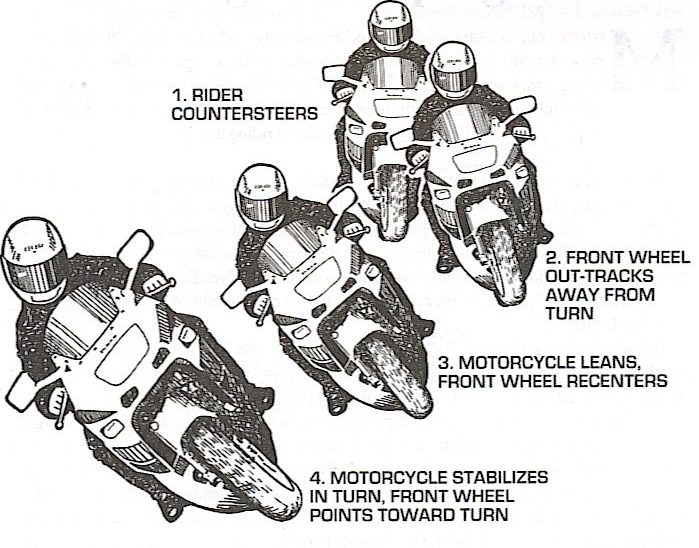
When riding at speeds above 10-15 mph, if you push on the right handlebar, the bike leans right and turns right. If you push on the left handlebar, the bike leans left and turns left.
Yes, you read that correctly. To turn right, you push right. To turn left, you push left.
🔍 Why does this happen? It’s all about physics—specifically, gyroscopic forces and centrifugal force. When you apply pressure to the handlebars, you momentarily change the direction of the front wheel, which forces the bike to lean into the turn.
How to Practice Countersteering
- Find a safe, open road or parking lot.
- Ride at 15 mph or faster (countersteering doesn’t work at slow speeds).
- Gently push the right handlebar and feel how the bike leans right.
- Try the same on the left side.
🏍 Scenario:
You’re cruising along a backroad when a sharp right-hand curve sneaks up on you. Instead of panicking and stiffening up, you remember countersteering: press right, lean right, and smoothly follow the turn. Crisis averted!
2. Body Position: The Secret Weapon for Stability and Control
Your body position has a huge impact on how your bike handles, especially in curves. A well-positioned rider can navigate turns smoothly, while a stiff or misaligned rider can make the bike feel unstable.
Basic Body Position for Everyday Riding
✅ Keep your arms relaxed and avoid a death grip on the handlebars.
✅ Keep your knees gripping the tank for better stability.
✅ Keep your head and eyes up, looking through the turn—not down at your front wheel.
Leaning into Turns: How Much Is Too Much?
There are different styles of leaning, depending on your riding style and speed:
- Standard Street Riding – Your body stays mostly upright with the bike, but you lean slightly into turns.
- Sport Riding / Canyon Carving – Shift your upper body slightly toward the inside of the turn for better balance.
- Track / Aggressive Riding – Full body positioning, hanging off the side of the bike like a MotoGP racer.
🏍 Scenario:
You’re going through a turn but feel the bike resisting. Instead of stiffening up, you remember to relax your arms, grip the tank with your knees, and lean slightly into the turn. Suddenly, the bike feels smooth and predictable.
3. The “Look Where You Want to Go” Rule
Your bike follows your eyes—so make sure you’re looking where you want to go, not where you don’t want to go!
❌ Mistake: Fixating on a pothole or the edge of the road.
✅ Solution: Look through the turn and focus on your exit point.
🏍 Scenario:
You enter a corner a little too fast, panic, and stare at the guardrail. Before you know it, you’re heading straight for it! Instead, you remind yourself: “Look through the turn!” You shift your eyes to where you want to go, and the bike follows—disaster avoided.
Final Thoughts: Ride Smooth, Ride Smart
Understanding countersteering and body position isn’t just about making riding easier—it’s about making it safer. The more you practice these techniques, the more natural they’ll feel.
✅ Practice countersteering on a quiet road.
✅ Work on keeping a relaxed, stable body position.
✅ Always look where you want to go!
Master these skills, and you’ll not only be a safer rider, but you’ll also feel more in control—and have a lot more fun. Now, get out there and ride!
SHARE WITH THE WORLD